Talk it through. Read it clean.
A literature review, a methods section, a half-formed argument you need to get out of your head, the writing a thesis runs on, dictated and landing clean at your cursor. Citation surnames and technical terms come back spelled the way your field spells them. Phrasora captures your words and your field’s terms; the thinking stays yours.
Free for 2,000 words a week, no card. Mac, Windows, iPhone, Android, and the web.
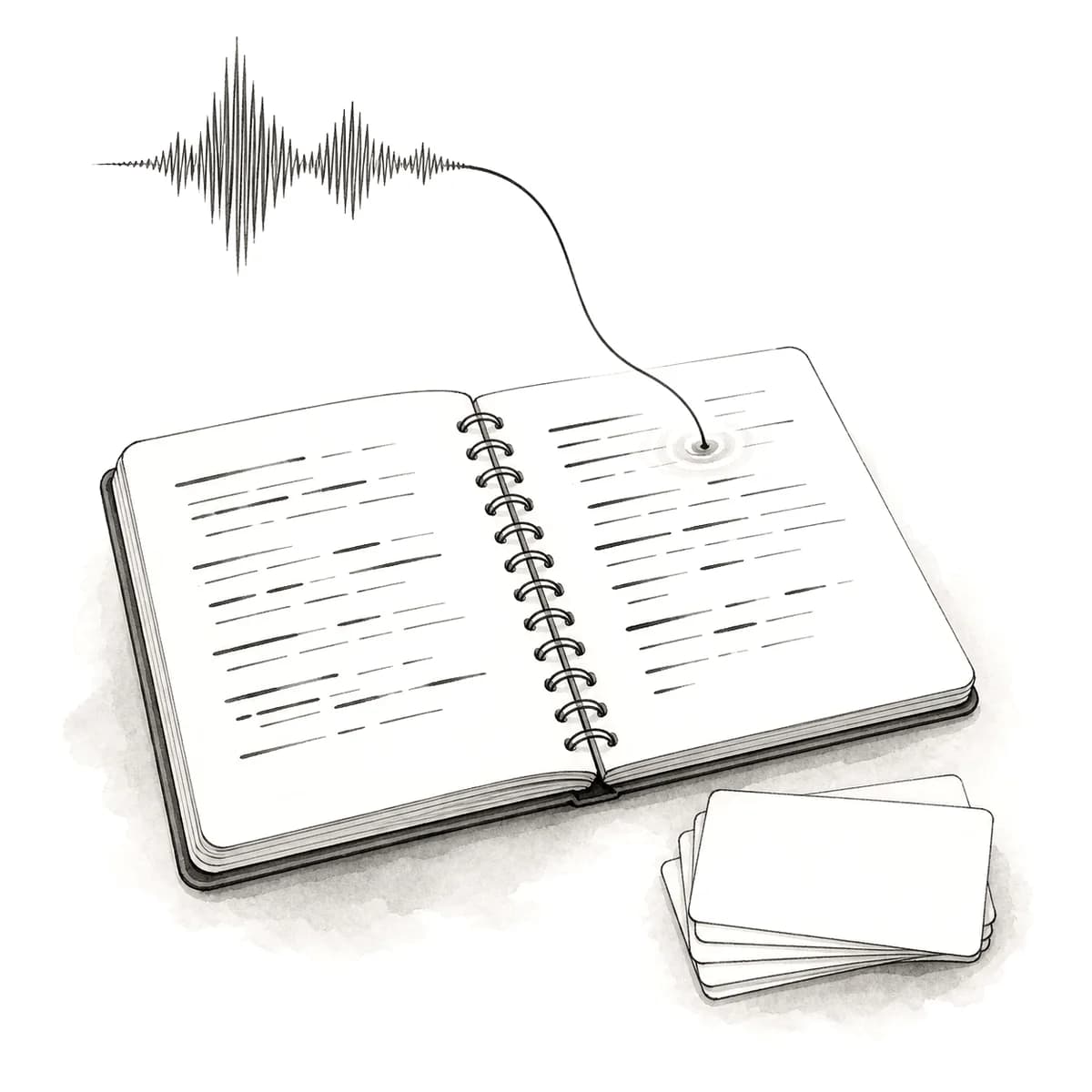
It learns the terms English never taught it.
A general speech model has never heard the species you study, the author you cite three times a page, or your advisor’s name. Phrasora gives the cloud transcription a short, focused hint from your own dictionary, so citation surnames, technical and Latin terms, and the names around your work come back the way you spell them. Batch transcription sends only terms supported by the speech; eligible exact-English real-time transcription can use a small bounded dictionary panel, including synced terms not spoken in that take. The hints guide spelling, they are not replacement rules.
For an obscure term, say it and then spell it, the letters always win over what was heard, and the correction is remembered across every device. Every learned term is announced with time to undo.
Dictionary hints guide spelling; they are not replacement rules.
the assay was run in caenorhabditis, C-A-E-N-O, following the protocol from heisenberg et al
PhrasoraThe assay was run in Caenorhabditis, following the protocol from Heisenberg et al.
Think out loud, get back a shape.
The hardest part of a chapter is the blank page. Talk through an argument the messy way it actually forms, circling back, restarting, thinking mid-sentence, and Structured mode strips the fillers and lays your points out as headings and bullets you can edit. It organizes what you said; it never invents what you didn’t. There’s no live transcript flickering as you speak to make you second-guess, the outline simply arrives when you’re done.
After you dictate, the Refine coach reads how you actually write and surfaces a handful of sharper word choices and tighter phrasing, suggestions only, never a rewrite, and never a “correction” to a line that’s already strong.
ok so for the discussion there’s like three things, um, the sample size was small, and also the timing thing, and we should mention the follow-up study
StructuredDiscussion
• Sample size was small.
• Timing of the intervention.
• Note the planned follow-up study.
Notes on the phone, drafting on the laptop.
Reading happens on the train, drafting happens at the desk, and a good idea shows up in neither place reliably. Phrasora works as a keyboard on iPhone and Android for quick reading notes, and pastes clean text at your cursor in any app on Mac and Windows when you’re writing for real, your word processor, a reference manager, a web form, your email.
It’s one account and one dictionary across all of it, so a term you taught it on your laptop is spelled right when you dictate a note on your phone. Four native clients and the web, kept in sync.
Reading notes from the phone keyboard.
Drafting at your cursor on the laptop.
One dictionary, synced across every device.
Free for 2,000 words a week, no card.
Measured, not marketed.
Word accuracy on 73 real human-speech recordings.
Median from key release to text at your cursor.
Median word error rate on that same set, before cleanup.
Native clients, Mac, Windows, iPhone, Android.
Latency and accuracy measured on the production pipeline, not a benchmark rig. Methodology in the engineering reports.
The questions students ask first.
Will it get my field's vocabulary and citation names right?
Yes, and it gets better the more you use it. Dictionary terms provide focused spelling hints: batch transcription sends only terms supported by the speech, while eligible exact-English real-time transcription can use a small bounded dictionary panel, including synced terms not spoken in that take. The hints are not replacement rules. For an obscure term, say it and then spell it, "Caenorhabditis, C-A-E-N-O", and the text reads it your way.
Can it turn a spoken brain-dump into an outline?
That's what Structured mode is for. Talk through an argument the messy way it actually forms in your head, and cleanup shapes it into headings and bullets you can edit, your points, organized, never invented. The Refine coach then surfaces sharper word choices and tighter phrasing after the fact, suggestions only, so the writing you do next is a little better.
Does Phrasora write my paper or check my facts?
No. Phrasora captures your words and your field's terms, down clean and organized, it transcribes what you said and tidies the formatting. It doesn't compose arguments for you, invent citations, or verify anything. The thinking, the sources, and the accuracy stay yours; Phrasora just gets them onto the page faster.
Is the free tier enough for a student?
For a lot of reading-note and drafting work, yes. The free tier gives you 2,000 words of dictation a week with no card, across the Mac and Windows apps, the iPhone and Android keyboards, and the web. When you need more, Pro is $10 a month or $96 a year, with a 14-day trial that doesn't ask for a card.
Get the chapter out of your head.
Free for 2,000 words a week, no card required. Talk through your next section, watch the terms land right and the points organize themselves, then judge it on your own work.